LEAF & ROOT October 2026 Update: How LEAF Performs During Nasdaq Drawdowns

October Performance
October was a difficult month for the Nasdaq, giving us another opportunity to evaluate LEAF's defensive positioning.
QQQ declined 6.7%, while LEAF fell 4.2%. ROOT, our Risk Off Overlay Tool, managed a small gain of 0.1%.
October returns:
QQQ: −6.7%
LEAF: −4.2%
ROOT: +0.1%
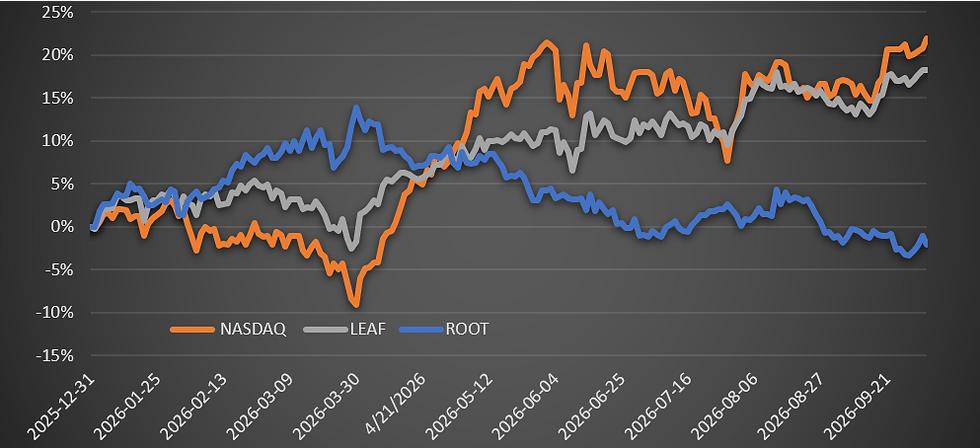
Year to date (as of October 30):
QQQ: +12.4%
LEAF: +12.8%
ROOT: −2.1%
LEAF captured approximately 63% of the Nasdaq's downside during October, outperforming QQQ by 2.5 percentage points.
While we would obviously prefer positive returns, October was a useful demonstration of why we combine leveraged equity exposure with a diversified Risk Off portfolio.
What Happened Underneath LEAF and ROOT?
October produced some significant differences in performance among the underlying positions.
Holding | October Return |
TQQQ – 3x Nasdaq | −20.5% |
SVXY – Short VIX Futures | −5.1% |
UGL – 2x Gold | −13.7% |
VIXM – Mid-Term VIX Futures | +2.6% |
CTA – Managed Futures | +4.3% |
KOLD – Inverse Natural Gas | +18.9% |
DLR.TO – US Dollar | −1.5% |
FGLS – Global Long/Short | +18.4% |
The Risk On side struggled. TQQQ was down approximately 20.5% as the Nasdaq declined, while SVXY lost 5.1%.
The more interesting action was again underneath ROOT.
KOLD and FGLS were the strongest performers, each gaining approximately 19%. CTA Managed Futures also contributed positively, rising 4.3%, while VIXM gained 2.6%.
Leveraged gold was the largest disappointment, with UGL losing 13.7%. The US dollar exposure was also modestly negative.
This is precisely why we hold multiple Risk Off strategies.
We don't expect gold, volatility, managed futures, currencies and other alternative investments to all work at the same time. In October, gold offered little protection, while several of the other positions performed considerably better.
Despite the weakness in some holdings, ROOT managed a small positive return while the Nasdaq declined nearly 7%.
How Has LEAF Performed During Nasdaq Drawdowns?
October's market decline prompted us to revisit LEAF's historical downside protection.
One of the primary objectives of LEAF is to participate in rising equity markets while limiting losses during significant Nasdaq corrections.
We examined LEAF's performance during QQQ drawdowns going back to September 2011.
The results were interesting.
The chart below compares QQQ's drawdown from its previous high with LEAF's return over the same period.

Each drawdown begins when QQQ falls below its previous high and ends when it establishes a new high. Both series reset at the beginning of each new drawdown, so the gaps between observations represent separate periods rather than sudden changes in portfolio value.
The results are particularly interesting during prolonged market declines.
During the 2022 bear market and subsequent recovery, QQQ fell more than 30% below its previous high. Meanwhile, LEAF eventually generated gains exceeding 40% before QQQ fully recovered.
This illustrates an important distinction. LEAF's defensive positioning has historically helped limit losses during market declines, but it has also allowed the strategy to generate positive returns while QQQ remained below its previous high.
We measured LEAF's performance from the beginning of each QQQ drawdown to the subsequent market low.
QQQ Drawdown | LEAF Downside Capture |
Greater than 2% | 41.2% |
Greater than 5% | 33.3% |
Greater than 10% | 29.2% |
Greater than 20% | 11.6% |
Historically, LEAF has captured approximately one-third of QQQ's aggregate losses during corrections of 5% or greater.
More interestingly, the downside capture ratio has generally declined as market drawdowns become more severe.
During the four QQQ drawdowns exceeding 20%, LEAF captured approximately 12% of the aggregate peak-to-trough losses.
Of course, four major drawdowns is a relatively small sample, and we shouldn't assume the same results will occur in the future.
Why This Matters
Large losses are particularly damaging to long-term returns.
A portfolio that declines 50% needs to gain 100% just to get back to even.
Reducing those losses can make a meaningful difference to long-term compounding, even if it means giving up some upside during strong equity markets.
This is the trade-off we are trying to manage with LEAF.
We use leveraged equity exposure to pursue growth, while ROOT provides a diversified collection of investments that can behave differently when markets come under pressure.
Final Thoughts
October was not a particularly good month for LEAF in absolute terms, but its defensive allocation helped reduce the impact of a significant Nasdaq decline. Gains in ROOT positions were used to buy the dip in stocks.
ROOT finished slightly positive, with strong performance from inverse natural gas, global long/short equities and managed futures offsetting weakness elsewhere.
The historical drawdown analysis also provides some useful perspective. LEAF has generally experienced much smaller losses than QQQ during substantial corrections, with downside capture becoming particularly low during the largest market declines.
We don't expect LEAF to outperform in every month or avoid every correction.
The objective remains to capture attractive long-term equity returns while taking considerably less downside risk during difficult markets.
Performance figures are based on historical model indexes. Drawdown capture statistics use aggregate historical observations and are sensitive to the calculation methodology. Historical and backtested performance is not a guarantee of future results.